
1066 - 1540 The Middle Ages including Reading Abbey
In the Middle
Ages Reading was a wealthy place and a centre of religion and pilgrimage.
1066
Though still less
important than Wallingford, Reading was the only other borough in
Berkshire and is listed as royal property.
After victory at Hastings William the Conqueror gave land from
Reading to Battle Abbey, founded on the site where he gained his throne.
The name Battle Hospital and Battle School are connected to this.
Reading
Abbey
Under the
spiritual patronage of the Blessed Virgin Mary and St John the Evangelist,
the Abbey was closely linked for over four hundred years not only with the
town's religious life but also with its commercial aspirations.
It contributed to the progress of education, literature, art,
commerce and brought the life of the borough into touch with the life of
the nation. The Abbey was
also concerned for the welfare of the poor and sick and with hospitality
for pilgrims.
The
confrontations between the Abbot and the merchants’ guild took place in
the Abbey's Inner Gateway. Now
restored, it is one of the three remaining buildings of the Abbey and in
the 18th Century it housed the Abbey School for Girls.
The school’s most renowned pupil was Jane Austen.
The other surviving buildings are St Lawrence’s church and the
Hospitium dormitory, now also restored.
The Norman king
Henry Beauclerc, who reigned as Henry I (1100 -1135) the ‘refounder of
the English nation’, earnestly sought the welfare of his subjects,
particularly the poor and the defenceless.
The reign of ‘the lover of peace’ and the ‘great and glorious
father of his country’ occurred at a time of moral and religious reform.
He was a liberal benefactor to charitable and religious activities,
in particular to the Benedictine Order at Cluny, France, and to their
headquarters in England at the Priory of St Pancras at Lewes, Sussex.
This reformed branch of Benedictines, known as the Cluniacs,
usually settled on the edge of a town and their emphasis was on beauty in
both worship and buildings.
A famous relic,
the reputed hand of St James, came into Henry's possession and in response
he wished to build a splendid establishment worthy of the apostle.
He also intended it
to be a memorial place to himself and his family.
Out of his own lands,
Henry chose the location of Reading and asked the Prior of Cluny to
establish a monastery there.
William of
Malmesbury recorded:
‘Henry built
this monument between the rivers Kennet and Thames, in a spot calculated
for the reception of almost all who might have occasion to travel to the
more populous cities of England, where he placed monks of the Cluniac
order, who are to this day a noble pattern of holiness and example of
unwearied and delightful hospitality.’
1120
The Abbey was
built under the orders of Henry I, whose body was buried there in front of
the high altar.
1121
On 18th June, in
the presence of his successor Stephen and barons, Henry I laid the
foundations to the house of God on his own lands in Reading.
1121
The town was
annexed to the monastery to which it then owed fealty.
The Abbot not only owned the natural resources but also controlled
the market and manufacture of cloth as well as appointed the Warden and
junior officers of the Guild Merchants.
Pleading
privileges and rights from pre-Conquest times when Reading was a royal
borough, the Guild began to revolt against the supremacy of the Abbot. During the reign of Henry III (1216-1272) many involved in
the revolt resorted to violence.
Reading Abbey was
designed and built by the Priory of St Pancras at Lewes, the main
monastery of the Ciuniac Order in England (Interestingly the town now
burns an effigy of the Pope instead of Guy Fawkes on November 5th).
1123
The first Abbot
Hugh was appointed.
All this time
Reading was one of the six richest abbeys in England.
The Abbey brought
major town development to Reading through trade and Pilgrimage to and from
London, Oxford, Bristol, Winchester and Southampton.
Pilgrims came, drawn by both the Abbey and the nearby shrine of Our
Lady of Caversham.
Where the three
parishes of St. Mary, St. Lawrence and St. Giles met stood the medieval
Guildhall (Yield Hall) for the town’s government.
1125
The Abbey’s
foundation charter was signed by the king on 29th March.
1126
Henry I donated
the relic of a hand of St James to the Abbey which resulted in Reading
becoming a centre of pilgrimage and associated with the major pilgrimage
to Compostella.
1136
Burial of Henry I
before the high altar of the Abbey church.
1150
During the civil
war with Matilda, the daughter of Henry I, Stephen, Henry's nephew and
heir, built a castle in the Abbey grounds.
It was destroyed in 1152 but it's earth mound is probably Forbury
Mound in Forbury Gardens.
1164
The Abbey church
was completed and consecrated "to the worship of God for ever and
ever" by Thomas Beckett, Archbishop of Canterbury, in the presence of
Henry II.
1185
Visit of
Heraclius, the Patriot of Jerusalem, with the Master of the Knights
Hospitallers to offer Henry II the crown of the Christian Kingdom of
Jerusalem, which then stood in grave danger from the infidels.
To the most powerful and effective ruler in Europe they brought
letters from the Pope together with the keys of the Tower of David and of
the Holy Sepulchre. Although
deeply distressed, Henry declined the offer.
1191
Curch of St
Giles’ exact year of founding is unknown, but certainly built by 1191.
With St. Mary's and St. Lawrence, St Giles was one of the three
major churches in Reading.
1200’s
Inpired by the
Celtic monastery in Bobbie, northern Italy, Francis of Assisi evangelised
and served people in a simple life of poverty and obedience to the Lord.
This was in stark contrast to the corrupt luxury in the church.
Franciscan Greyfriars, followers of Francis of Assisi, were allowed
to settle, first on marshy ground near Caversham Bridge.
From the 1280’s they were allowed to build a new church at the
western end of New Street, which in consequence became known as Friar
Street.
The Abbott, as
Lord of the Manor of Reading, also represented the civil and legal
power of the King. By
overriding the merchants’ claims to borough government, this produced
great local resentment. The
result, especially in the 1230’s, was conflict between the Abbey and the
leading merchants. This
conflict only began to be resolved when the town received its first royal
charter in 1253.
The town of
Reading prospered. People
came to seek work from as far a field as the South Coast, the Midlands and
Wales.
As a result of
which the population trebled between 1300 and 1500.
1279
One of three
councils convened by the Papal Legate, a national church council was held
at the Abbey presided over by the Archbishop of Canterbury.
The purpose of the council was to discuss church reforms, but some
were too radical for King Edward I who introduced his own reforms.
1300
A well dating
back to this time was discovered in 1983 in Cross Street.
1453
Fear of the
plague caused Henry VI to summon England's parliament to meet in the
Abbey. On one of three such
occasions, the Commons met in the Chapter House, and the Lords in the
Refectory.
1464
Public
announcement in the Abbey church during Edward IV's visit of his secret
marriage to an English bride, contrary to diplomatic expectations for a
French princess.
1485
The Abbey’s
Hospitium, the guest house for pilgrims, was converted into the Royal
Grammar School of King Henry VII. Later
this became Reading School.
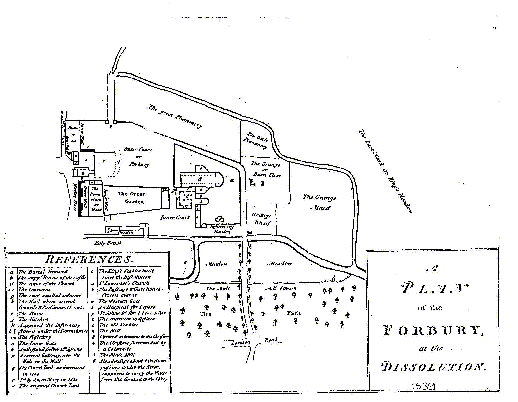
1539
Reading was among
the last of the great monasteries to be dissolved by Henry Vlll’s legal
looting of church property. Abbot
Hugh Cook Farringdon was one of only three Abbots who denied Henry
Vlll’s supremacy over the Pope. When
the Abbey was dissolved on 19 September 1539, Abbot Hugh was sent to the
Tower for treason. On 14
November, after a rigged trial, he was executed outside his Abbey gate by
hanging, drawing and quartering.
The vicar of St.
Giles, John Eynon, a monk with close links with the Pope, together with
two other monks, were executed with Abbot Hugh Farringdon.
All the three
parish churches were passed to the Crown.
Unlike at
Gloucester, no attempt was made to preserve the Abbey church for the
parish after the dissolution of the monasteries and the Abbey buildings
were soon virtually demolished.
Do events
from the past have any influence on the way we are today?
- The
Abbey was consecrated “to the worship of God forever and ever”.
Many Pilgrims came.
- The
Abbot was also Mayor of Reading producing resentment among the town
merchants.
- The
Abbey was affluent and entertained royalty and parliament.
- Execution
of the last Abbot along with the Vicar of St Giles.
1066 - 1540 The Middle Ages including Reading Abbey
1540-1700 including The Civil War
Historical Streets and Places in Reading
Praying together for Reading - What is God doing?
Words, Pictures, Prophecies and Promises
Principle Sources and Further Reading